

I spent twenty three years in critical care, twenty of them on night shifts, and for most of that time I thought a scratchy morning throat was just part of the job. Hospital air is recirculated and climate controlled all shift long, and I used to walk out at seven in the morning feeling like I'd swallowed sand. What I didn't clue into for years was that I was coming home to the exact same problem in my own bedroom, because our forced air furnace runs bone dry every winter. The fix that finally stuck for me was an AquaOasis Cool Mist Humidifier set up correctly on my nightstand, not just plugged in and forgotten.
If you're waking up with a dry, scratchy throat most mornings, and it eases up once you've been awake and drinking water for a while, dry indoor air is one of the most common and most fixable causes. A humidifier can genuinely help with this, but only if it's set up correctly. I've watched enough people buy one, run it wrong for two weeks, decide it doesn't work, and shove it in a closet. This is the exact setup I use, step by step, so you don't waste the same two weeks I've watched other people waste.
One honest note before we start. A dry throat that lingers all day, comes with pain swallowing, fever, or doesn't improve with humidity and hydration, is worth a conversation with your doctor. Dry indoor air is a common and treatable cause of a scratchy morning throat, but it isn't the only one, and I'd rather send you to get checked than have you chase a humidity fix for a problem that needs something else.
The tool that actually gets a bedroom back to a comfortable humidity level
Before you touch the thermostat or start taping plastic over vents, get a real humidifier with a tank big enough to run all night. This is the one I've kept running on my own nightstand for six months straight.
Amazon Check Today's Price on Amazon →Step 1: Figure out how dry your bedroom actually is
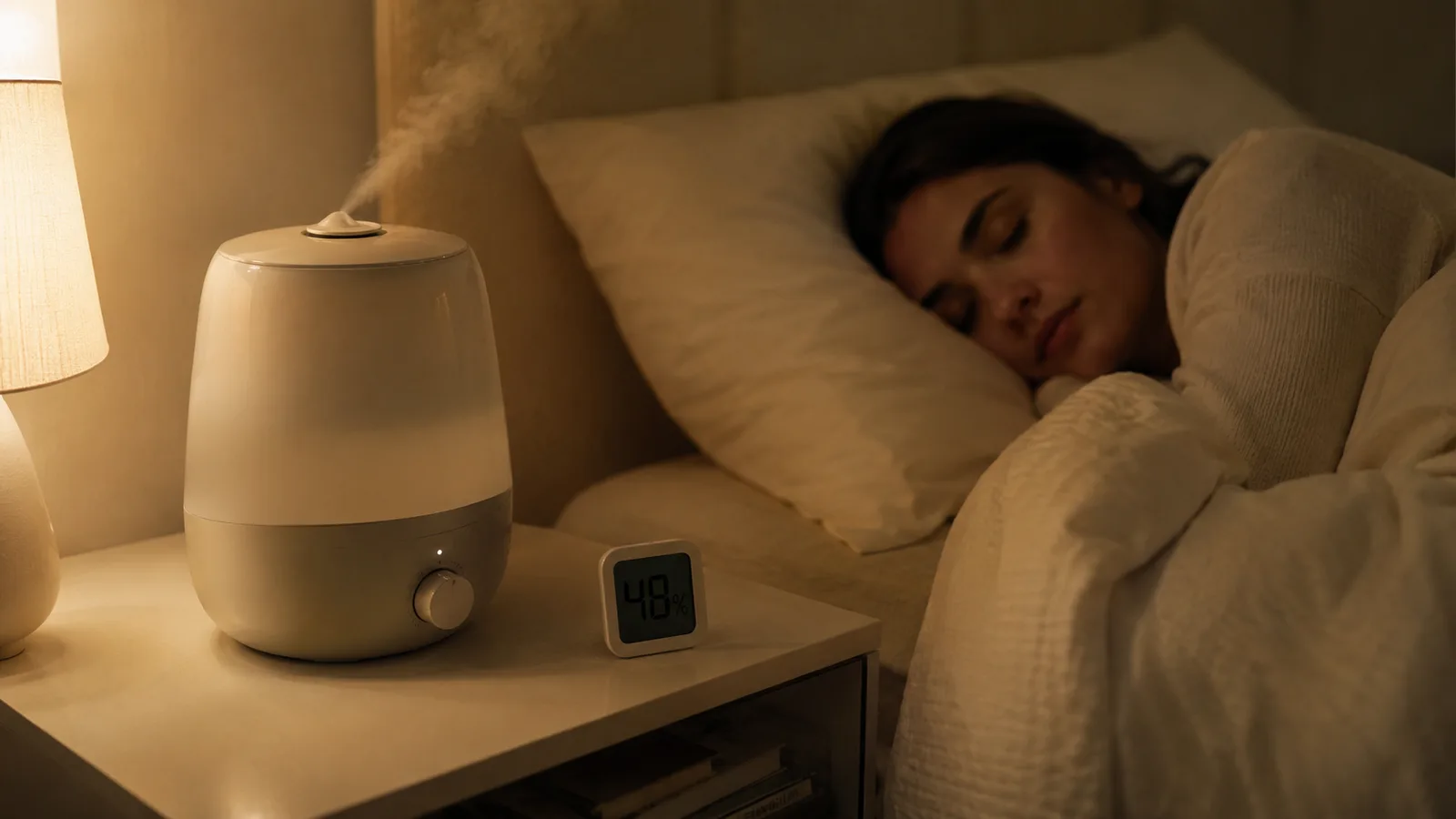
Most people skip straight to buying a humidifier without ever measuring the problem, and then they either run it too little to matter or too much and end up with damp windows. A small digital hygrometer costs about ten dollars and tells you the relative humidity in your room in seconds. I keep one on my dresser year round, and in the dead of a forced air winter, my bedroom used to read as low as eighteen percent before I started actively managing it, which is drier than a lot of deserts.
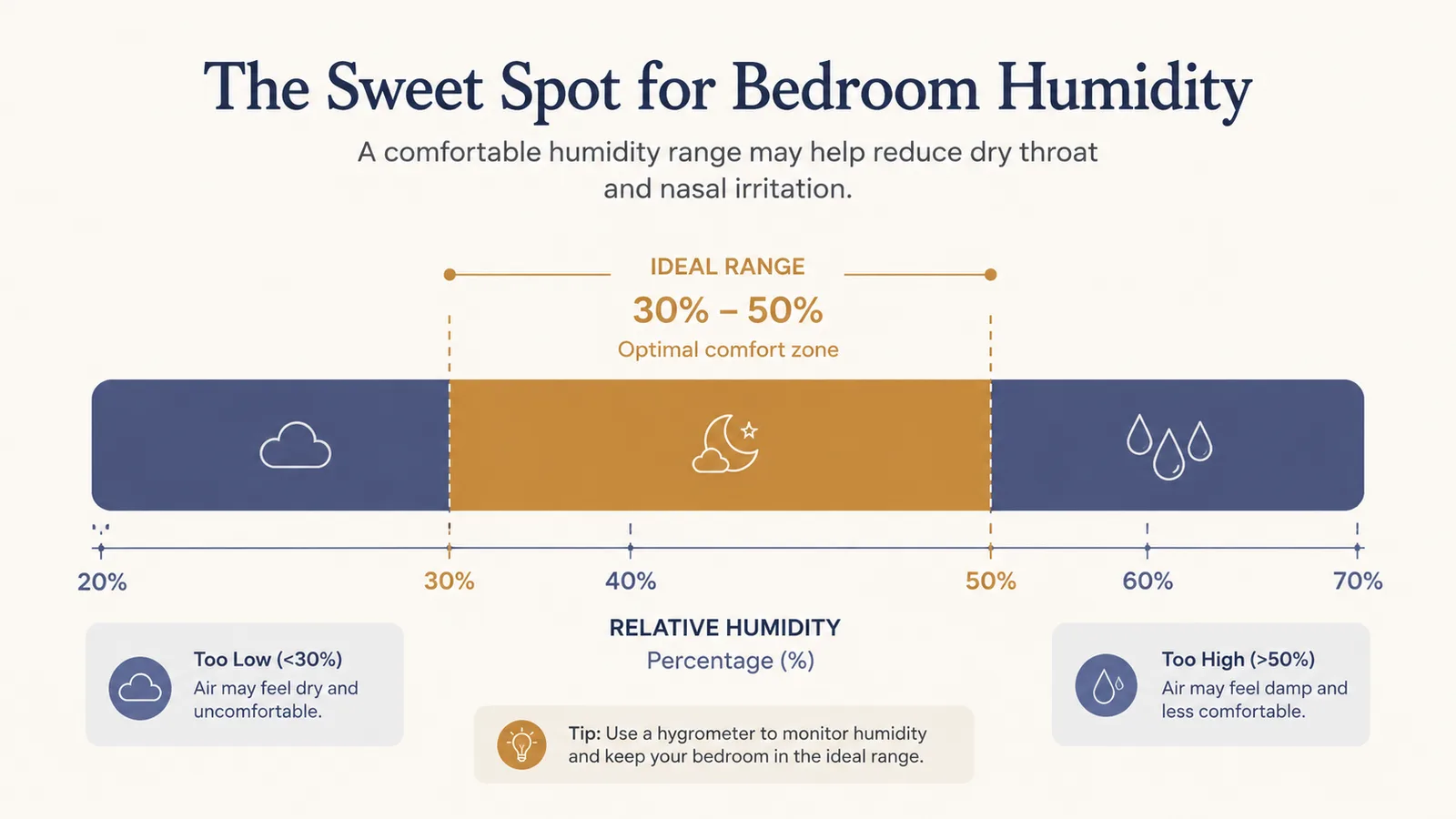
The general comfort range most people sleep best in is somewhere between thirty and fifty percent relative humidity. Below thirty, you'll typically notice dry throat, dry nose, and skin that feels tight by morning. Above fifty, you risk the opposite problem, condensation on windows and a musty feeling in the room, which isn't what you want either. Check your number before you do anything else, so you know whether you're solving a mild problem or a serious one.
I check mine a few times a week, mostly out of habit at this point, but it's genuinely useful information. If your reading is already sitting around thirty five percent and you're still waking up with a dry throat, the humidifier alone probably isn't your whole answer, and it's worth looking at whether you're breathing through your mouth at night or dealing with something else entirely. If your reading is down in the teens or low twenties like mine used to be, a humidifier running correctly overnight is very likely to make a real difference.
Step 2: Put the humidifier where it can actually reach you
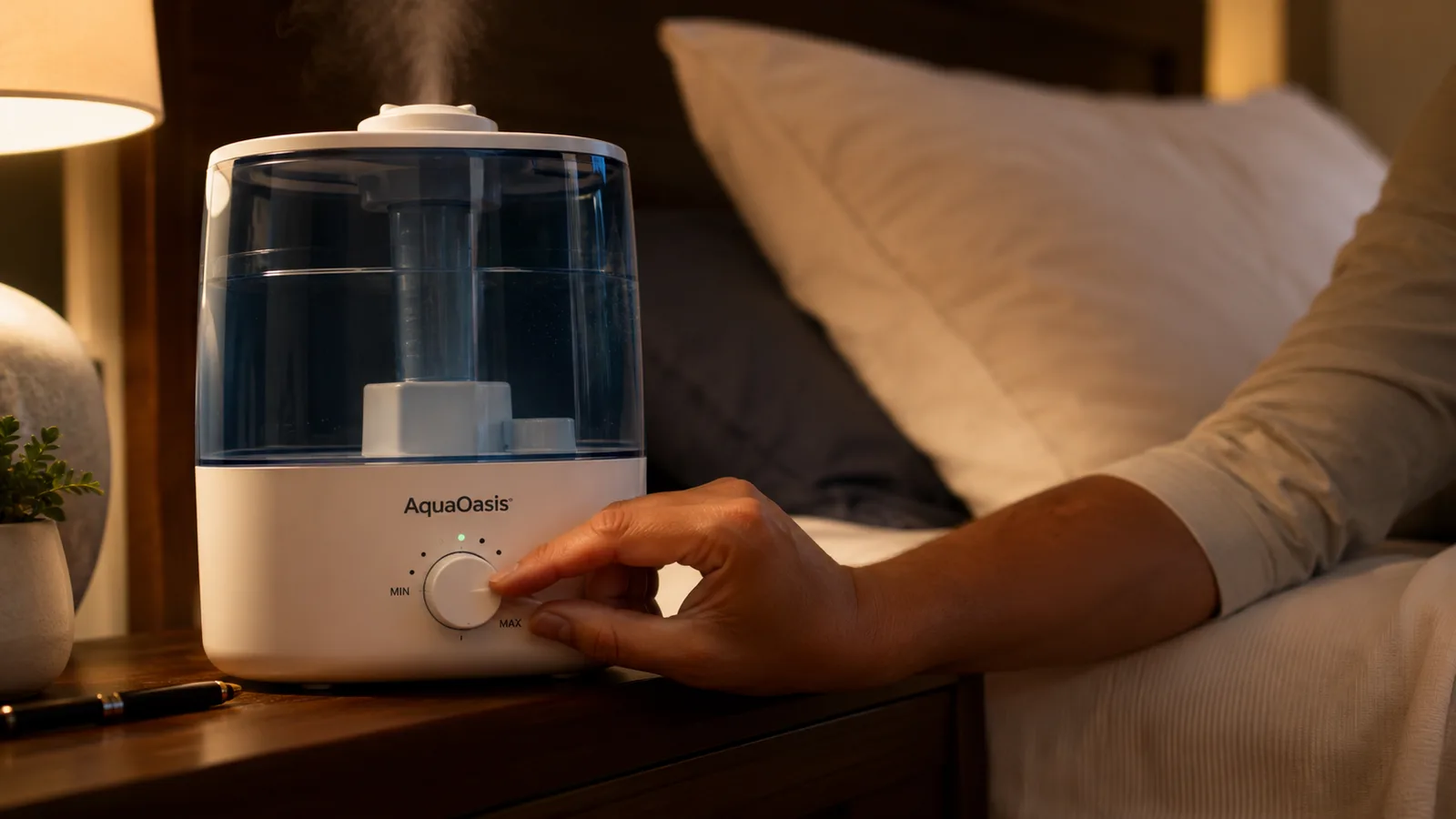
This is the step almost everyone gets wrong, and it's the reason so many people think humidifiers don't work when really the placement never gave the mist a fair chance. Setting a humidifier across the room, tucked in a corner behind the dresser, means most of that moisture never makes it to the air you're actually breathing while you sleep. I learned this the hard way with a cheaper unit years ago that I'd shoved behind a lamp on a shelf across from my bed, and it did almost nothing I could feel.
The AquaOasis sits on a folded towel on my nightstand now, roughly three to four feet from where my head lands on the pillow, close enough that the mist actually reaches the air around my face over the course of the night, but far enough that nothing gets damp on the wood. The 360 degree rotating nozzle lets you aim the plume slightly up and away from any papers or electronics nearby, which matters more than people expect, since a mist stream aimed straight at a lamp or a nightstand book over several months will leave it feeling faintly damp.
Give it some breathing room too. Don't tuck it directly against a wall or wedge it into a corner, since that restricts airflow around the unit and can make it work harder than it needs to. A flat, stable surface with a few inches of open space on at least two sides is all it needs, and a nightstand or low dresser near the head of the bed is usually the right call.
Step 3: Pick the right mist setting for the size of the room
Every humidifier I've owned has had at least a low and a high setting, and most people default to high because it feels like it's doing more. For an overnight bedroom setup, that's usually the wrong call. I run mine on low almost every night, which on the AquaOasis's 2.2 liter tank has reliably lasted through a full eight to nine hour sleep with water left in the tank by morning. Low mist is also quieter, and quiet matters enormously when you're trying to actually fall asleep rather than just fill the room with humidity as fast as possible.
If your bedroom is on the larger side, more than roughly two hundred square feet, or you have particularly dry conditions like a very cold climate with forced air heat running most of the night, medium can make sense. I bump mine up to medium during the day when the bedroom door is open and I'm trying to bring the whole upstairs hallway humidity up a bit, but I drop it back to low before bed every single night.
Watch your hygrometer for the first week while you dial this in. If you're waking up in the mid thirties or higher and your windows are showing condensation, that's your sign to drop the setting down, not push it further. The goal is steady comfort, not maximum mist.
Step 4: Use the right water, and stay ahead of the cleaning
This step is the one nobody warns you about, and it's the single biggest reason people end up disappointed with a humidifier. Ultrasonic units like the AquaOasis push whatever is in your tap water straight out into the air along with the mist. If your tap water is hard or high in minerals, you'll notice a fine white dust settling on your nightstand and dresser within a week or two. I switched to distilled water in the first month specifically for this reason, and it cut the dust down dramatically.
The tank itself needs a real cleaning about once a week to keep performing the way it did on day one. I use a mix of white vinegar and water, let it sit in the tank for ten or fifteen minutes, then scrub around the ultrasonic plate at the base with an old toothbrush before rinsing well. Skip this for a few weeks like I did once during a stretch of back to back shifts, and you'll notice the mist output visibly weaken, which is mineral buildup coating the plate and blocking it from working properly. One thorough vinegar soak brings it right back.
A humidifier that's dirty on the inside isn't just less effective, it can also push whatever's growing in that stagnant water out into the air you're breathing all night, which works against the entire reason you bought it in the first place. Set a recurring reminder on your phone if you're prone to forgetting, the same way I finally had to.
Step 5: Give it a full week before you judge the result
A single night with a humidifier running usually isn't enough to notice much of anything, and I think this is where a lot of people give up too early. Your mucous membranes, the tissue lining your nose and throat, take a little time to recover once they're finally getting consistent moisture overnight instead of drying out every single night for months. I tell people to commit to a full week of correct placement, the right mist setting, and clean water before deciding whether it's working.
Track it simply. Every morning, before you even get out of bed, rate your throat on a scale of one to ten, one being fine, ten being raw and painful. Jot the number down along with your hygrometer reading from the night before. By day five or six, most people I've talked to see a real, noticeable trend downward on that scale, alongside a bedroom that's holding steady somewhere in that thirty to fifty percent range instead of swinging low every night.
If a full week goes by with correct setup and no improvement at all, that's useful information too. It tells you dry air probably isn't the main driver of what you're waking up with, and it's a good reason to bring it up at your next doctor's visit instead of assuming a bigger, stronger humidifier is the answer.
What Else Helps
A few smaller habits stack well on top of a properly set up humidifier. I keep a glass of water on my nightstand and take a sip if I wake up mid sleep cycle, since even a small amount of overnight hydration makes a difference for me. I also stopped sleeping with my mouth open as much as I used to once I addressed a stuffy nose issue separately, since mouth breathing dries out a throat far faster than nose breathing does, humidifier or not.
None of these replace the five steps above, they just round out the picture. On the roughest weeks, coming off back to back overnight shifts, I lean harder on the humidifier and give myself grace about the rest. And on the nights I forget to fill the tank before bed, I notice the difference by morning almost immediately, which tells me more about how much it's actually doing than anything else could.
A dry throat most mornings usually isn't bad luck. It's usually just the air in the room you sleep in, and that part is fixable.
Set it up right tonight, not after another dry, scratchy morning
Grab a hygrometer, find a spot on your nightstand, and start with a humidifier that has a tank big enough to run all night on its own. Check today's price on the AquaOasis Cool Mist Humidifier before your next shift.
Amazon Check Today's Price on Amazon →